

part i — there is a door, and everyone brought a different game
say we need to steal a ledger from a guarded house.
there is a locked study upstairs. the servants are still awake. somebody patrols the corridor, although we have not established how often. we are currently standing somewhere we are not supposed to be.
the first question is how to reach the study without being noticed.
in d&d 5e, assuming the dm calls for a dexterity (stealth) check, the numbers on our sheets immediately become relevant. against a hypothetical dc 15, someone with a +7 modifier succeeds on an 8 or higher: a 65 percent chance. someone with +1 needs a 14: 35 percent.
sending the specialist is a consequential decision. the system makes that difference explicit through ability modifiers and relevant proficiency. the 2014 ability-check rules establish that calculation.
of course, we could distract the guard, obtain a disguise, or find another corridor. d&d permits all of that. but if the situation comes down to a check, specialization has a measurable effect on who should attempt it.
now imagine the same situation in cairn.
cairn also has attributes. a dangerous action can require a save against one of them. however, its principles explicitly allow a sensible solution to succeed without a roll, and its character structure does not offer the same broad catalogue of skill proficiencies. asking how the guard’s attention could be removed may therefore be more productive than searching the sheet for a specialized stealth bonus. cairn’s principles describe that approach.
this does not mean d&d requires a roll for every corridor, or that cairn rewards any plan described with sufficient enthusiasm. both still require judgment about the circumstances.
the distinction concerns the support available once we reach for the rules.
durf adds another pressure. significant exploration activities consume turns, and each turn brings an encounter check. pushing a character grants a buff but adds stress, which occupies inventory space. delay and extra effort therefore have explicit costs. “let’s spend longer checking everything” and “i push myself again” are choices with consequences beyond the immediate task. durf’s rules make those costs part of ordinary play.
then consider blades in the dark.
perhaps we take a devil’s bargain: an extra die if we accept that a servant recognizes us. that consequence happens regardless of the roll’s outcome. we have improved our chance of reaching the study by agreeing to a separate problem. the action-roll procedure provides this exchange.
all four groups might eventually reach the same room. all four might describe equally clever plans.
but the decisions attached to those plans are different.
one group weighs a specialist’s odds. another tries to change the circumstances enough that a save becomes unnecessary. another balances thoroughness against time and carrying capacity. another purchases a better chance with an agreed complication.
that is the part of system design i find interesting: the moment the rules give us a concrete reason to approach the same situation differently.
part ii — show me the rule that makes me care
i think claims about how games encourage people to play should survive a fairly simple question:
what, specifically, makes you think that?
if i describe a game as tactical, i should be able to identify decisions that its mechanics make tactically meaningful. if i describe it as encouraging dramatic trouble, i should be able to point to something more substantial than evocative artwork and a paragraph telling us to embrace the story.
otherwise, i am describing an association i have with the game.
there is room for that in a subjective article. i just want to know when i am doing it.
pathfinder 2e offers a useful example of a claim we can examine. characters ordinarily receive three actions on their turn. making repeated attacks normally incurs an increasing penalty: −5 on the second attack and −10 on subsequent attacks, with exceptions such as agile weapons. the multiple attack penalty directly changes the value of repeating an action.
this gives a player a reason to consider doing something else with an action. moving, raising a shield, or using an appropriate skill might produce more value than another increasingly inaccurate attack.
i can therefore explain why i associate the game with deliberate tactical choices. the action economy and penalty structure create an opportunity cost.
that is stronger than saying pathfinder players like planning.
old-school essentials provides a different example. its classic rules award experience for recovered treasure alongside defeated monsters. treasure creates a reason to enter danger, while the reward does not require fighting every creature between the party and the exit. the basic rules contain that advancement structure.
avoiding a fight can therefore be efficient play rather than skipping the activity that earns progress. add exploration time, light, and encounter procedures, and there are reasons to care about how long an expedition takes and what it consumes.
that does not make every old-school game mechanically identical. it also does not make attributes irrelevant. old-school essentials has class abilities, saving throws, attack rolls, and other statistical procedures. durf explicitly uses d20-plus-attribute rolls.
“d&d players look at their sheets; osr players look at the room” can capture a difference in emphasis, but it becomes misleading when treated as a literal rule.
a better comparison asks which parts of the sheet offer dependable solutions, which situations call for rolls, and what the system charges for uncertainty.
there are also different strengths of influence.
a rule can require a procedure once its conditions apply. a move triggers; an action consumes a resource; damage must be resolved.
a rule can encourage a choice by attaching a benefit or cost. a player remains free to choose otherwise, but the alternatives are no longer equivalent.
and a community can prefer a style that the rules support only loosely. that preference may be widespread and valuable without becoming mechanically compulsory.
i want to keep those distinctions visible. a system can force me to pay a cost if i choose an action. it usually cannot force me to want the action. what it can do is make certain choices more reliable, affordable, rewarding, or difficult to ignore.
over an evening, those differences accumulate. over a campaign, they can become habits.
part iii — getting better at the job, getting paid to make it worse
now return to the ledger.
suppose our character discovers that a friend is being held inside the house. rescuing them will complicate the operation.
almost any ttrpg can accommodate the decision to help. the relevant question is what the rules contribute when we make it.
in fate core, a suitable aspect can support a negotiated compel. accepting the complication earns a fate point; refusing normally costs one. fate points can then support later effectiveness through aspect invocations. the compel rules establish an actual resource exchange.
the player has a mechanical reason to allow a relevant commitment to become inconvenient.
that does not mean every inconvenient act earns a point. the complication needs to fit the aspect and be agreed through the procedure. its relevance matters.
d&d 5e’s 2014 inspiration rule can also reward portraying traits, ideals, bonds, and flaws, including accepting their drawbacks. the comparison cannot honestly be “fate rewards characterization, d&d never does.” the inspiration rules say otherwise.
the difference concerns how the reward is organized. inspiration is a discretionary award, and characters ordinarily either have it or do not. fate embeds the negotiated complication in a repeatable economy of earning and spending.
that gives me a reason to expect different pressures, while leaving room for a d&d table that uses inspiration actively.
blades adds several mechanisms pointing in a similar direction. desperate actions earn experience, and resistance lets players mitigate consequences at a possible stress cost. the system provides reasons to enter dangerous situations and tools for deciding which consequences to absorb. planning and engagement and stress and trauma show how those pressures connect.
this is more specific than saying the game wants reckless characters. recklessness alone tells us very little about the decisions involved.
heart goes further in a different way. advancement is connected to fulfilling selected beats, and beats can involve costly experiences such as suffering fallout. a difficult development can itself fulfill an advancement objective. the publisher’s discussion of beats gives concrete examples.
here, “something bad happened to my character” and “i made progress” can describe the same event.
dungeon world’s first edition offers another arrangement: misses award xp, while many intermediate move results introduce costs, compromises, or choices. it also rewards familiar adventure achievements through end-of-session questions. the first-edition play sheets show that combination.
the presence of xp on a miss does not prove that intentionally failing is always sensible. the fictional consequences can be severe. it does mean that failure contributes something to progression instead of functioning only as a lost opportunity.
masks makes emotional interaction mechanically consequential. misses earn potential, influence can shift labels, and opening up during comfort or support can lead to benefits such as clearing a condition or marking potential. the publisher’s extended play example demonstrates these exchanges.
relationships therefore affect capabilities and development. they do work that a decorative backstory cannot do by itself.
my opinion begins here: a game becomes particularly distinctive when it repeatedly connects its subject matter to what players gain, spend, risk, or change. i can bring a troubled character into any game. i pay attention when a game gives that trouble a procedure.
part iv — the axes, with evidence attached
this is the basis of the chart.
the horizontal axis runs from:
“we’ll wing it” ↔ “let’s check the rules”
it represents mechanical overhead: how many procedures, interacting options, and tracked resources we need to manage.
the vertical runs from:
“good plans”
to:
“good complications”
it represents the degree to which the system supports making complications productive, compared with improving our position and minimizing unwanted costs.
these are subjective judgments about the combined effect of several mechanics. a single rule rarely determines a whole placement.
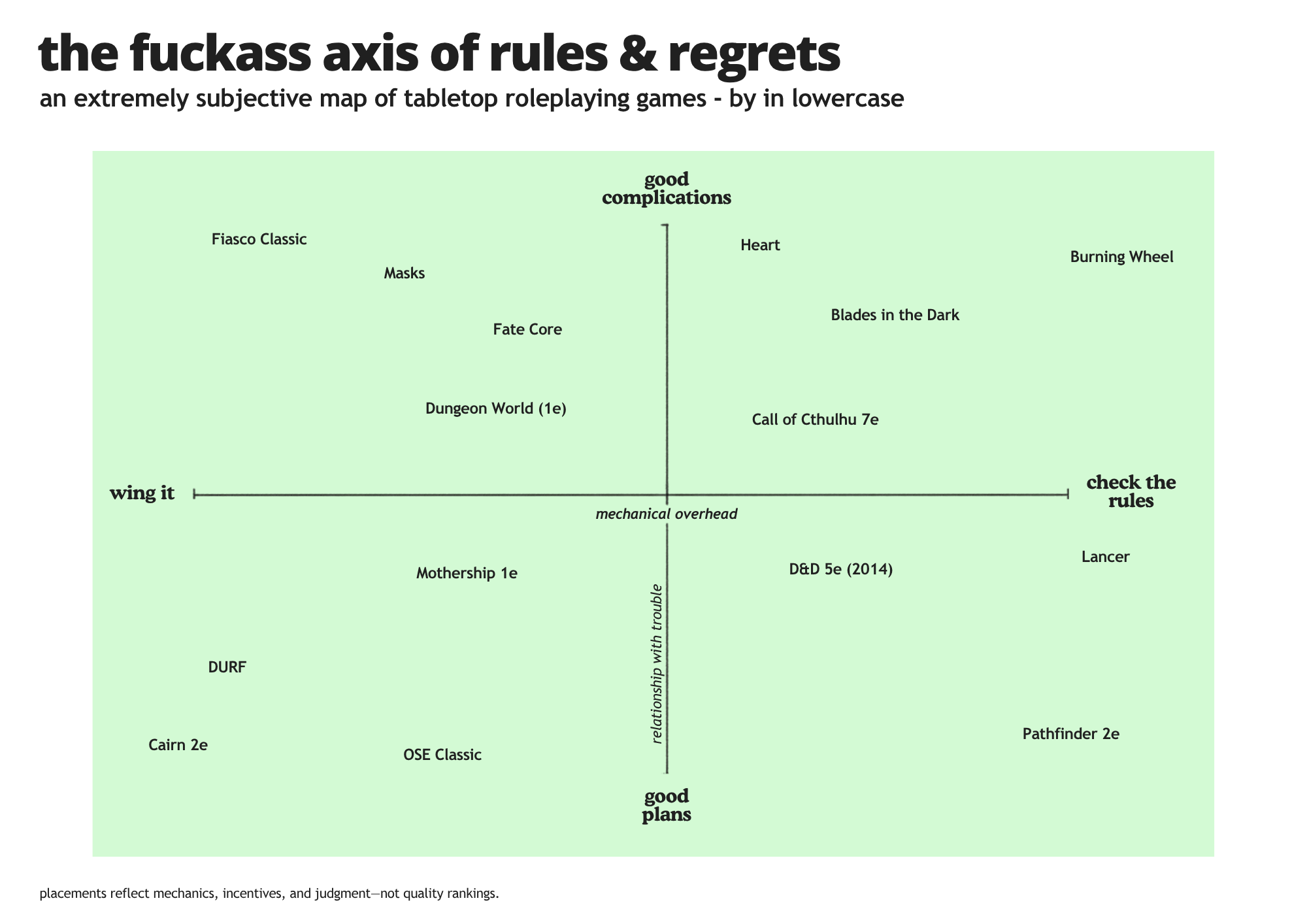
this map keeps fifteen examples: durf, cairn, old-school essentials, d&d, pathfinder, lancer, call of cthulhu, mothership, fate, blades, burning wheel, heart, dungeon world, masks, and fiasco.
cairn and old-school essentials sit toward the lighter, risk-management region for different reasons. cairn’s attacks automatically hit and proceed to damage, making an exchange of attacks a concrete exposure to attrition. old-school essentials combines treasure rewards with expedition procedures. both give players reasons to seek advantages before committing to uncertain confrontation. cairn’s combat rules make its particular pressure clear.
pathfinder sits farther right because more of its tactical decisions operate through explicit, interacting rules. its position reflects what that detail asks players to manage.
lancer occupies a nearby region when we emphasize mech combat. loadouts, actions, and heat create interacting tactical resources. overcharging offers an additional quick action in exchange for heat. taking a risk can serve a calculated attempt to complete the mission; the willingness to risk something does not automatically place a game near the top. the free player rules provide the relevant combat framework.
burning wheel gives us a reason to populate the upper right. beliefs, instincts, and traits connect to artha rewards, which players can spend on tests. pursuing commitments and completing personal goals participate in a mechanical cycle, alongside detailed advancement and conflict procedures. its core rules and play materials make that combination available for inspection.
this matters because mechanical density and dramatic commitment can reinforce each other. extensive rules do not necessarily point toward minimizing trouble.
fiasco classic sits toward the lighter upper region for a different reason. players choose whether to establish or resolve their scenes, with the complementary responsibility going to others. outcome dice, the tilt, and the aftermath structure participation in a developing disaster. the mechanics give players responsibilities beyond improving a character’s chances at a task. fiasco classic is a useful boundary example for that reason.
call of cthulhu and mothership complicate the middle and lower regions.
in call of cthulhu 7e, an eligible failed skill roll can be pushed through a justified new attempt, accepting more severe consequences if it fails again. that is explicit support for escalating a risk. it is not a general reward for suffering, and combat rolls cannot simply be pushed. the skill procedure and combat rules define the distinction.
mothership’s failed stat checks and saves add stress, which interacts with panic. that creates a reason to avoid unnecessary exposure. its longer recovery cycle adds nuance: shore leave can turn reduced stress into improved saves. immediate survival pressure and long-term development do not point in exactly the same direction. the publisher’s rules introduction and first-edition development notes explain those elements.
neither game belongs high on the chart simply because terrible things happen in it.
part v — the rules should survive the removal of the adjectives
there is a useful test for everything i have said so far.
remove the words “tactical,” “narrative,” “old-school,” “cinematic,” and “character-driven.”
can i still explain why i placed the game where i did?
for pathfinder, i can discuss three actions and the declining return on repeated attacks.
for old-school essentials, i can discuss experience from recovered treasure and the costs of an expedition.
for fate, i can discuss accepting a relevant complication in exchange for a spendable point.
for heart, i can discuss an advancement condition that makes a particular troublesome experience something the player has reason to pursue.
those explanations give us something to evaluate. someone can argue that i have exaggerated a mechanic’s influence, ignored a countervailing procedure, or weighted one part of the game too heavily. we can inspect the disagreement.
that is the kind of subjectivity i want in this essay: an interpretation with reasons attached.
it also gives a better answer to the objection that another system could handle the same event. of course it could. another group can invent a similar ruling, encourage the same behavior socially, or import a procedure. the scene does not belong exclusively to one game.
what differs is the support provided before that extra work happens.
does the game already offer the exchange? does it apply consistently? can the player anticipate it? does it connect to progression, recovery, or another resource used throughout play?
a spontaneous reward and a recurring procedure can produce the same result once. over time, the recurring procedure gives players something they can deliberately build decisions around.
that is why mechanics matter to this comparison.
they do not determine everything people will do. they establish some of the terms on which decisions become attractive.
a high bonus makes specialization attractive. a timer makes delay costly. an encounter check makes another search consequential. an advancement trigger gives a player a reason to seek a particular experience. a bargain lets someone decide that a future problem is worth a better chance now.
my preference is to choose games with those exchanges in mind.
if i want an evening about carefully extracting something valuable, i want to know how the game supports preparation, information, and getting out. if i want a character’s commitments to keep making their life harder, i want to know whether the system gives that choice sustained mechanical support. if i want both, i want to see how the procedures pull against each other.
the chart is a way of making those preferences discussable.
we can still break into the same house. we can still improvise, make speeches, find clever solutions, and behave terribly. the rules give different weight to what happens along the way.
and that is the point i actually want to make: the action can look identical in the fiction while being a different decision in the game.
the character opens the forbidden door.
one system asks whether the modifier is high enough. another has already made us account for the time, equipment, and exposure. another offers an extra die if we agree that someone will find out.
another lets us mark advancement because opening that door was exactly the terrible experience we signed up for.
so yes, any of these games can contain bad decisions.
i just want to know whether mine will be charged to my hit points, my inventory, or my professional development.
Great post. Thanks for putting this all together. An additional point about CoC 7e that may impact how you chart it comes from the ability to increase skills successfully used during the game. Players check a box next to all successfully used skills and then may be able to increase those by d10 after the session. This character sheet driven rewards system falls in line with other games you mention.